Share It On:
 Your website traffic means nothing if visitors leave without converting. CRO transforms passive clicks into measurable business outcomes without spending more on acquisition. Here's why it's the highest-ROI investment your website can make.
Most businesses spend the bulk of their marketing budget getting people to their website. SEO, paid ads and content all of it works toward pulling in traffic. But here's the uncomfortable reality: more than 97% of website visitors leave without taking any action. That's not a traffic problem. That's a conversion problem.
Conversion rate optimization (CRO) is the discipline that closes that gap. It's the process of turning your existing visitors into leads, subscribers, or paying customers without increasing your ad spend by a single dollar. For B2B marketers, brand managers, and business owners, it's arguably the most capital-efficient growth lever available.
This editorial breaks down what CRO actually means, why it matters for websites of every size and sector, and what a structured CRO strategy looks like when executed properly.

What is Conversion Rate Optimization (CRO)?
CRO is the structured, data-driven process of increasing the percentage of website visitors who complete a defined goal, a purchase, a demo request, a form submission, a newsletter signup, or any other action that signals business value.
The formula is straightforward:
|
Conversion Rate = (Number of Conversions ÷ Total Visitors) × 100 |
If 10,000 people visit your website and 200 fill out a contact form, your conversion rate is 2%. CRO works to push that number higher, not by attracting different visitors, but by making the experience more compelling and friction-free for the visitors you already have.
What CRO is not? It's not guesswork, it's not a one-time redesign, and it's certainly not about changing your button color and hoping for the best. It's a repeatable, evidence-based discipline.
What is CRO in Marketing Today?
In 2026, understanding CRO in marketing has evolved beyond simple button color testing. It now encompasses psychological triggers, technical performance, and predictive user behavior. Modern CRO marketing focuses on reducing cognitive friction. If a user has to think too hard about their next step, you have already lost them. Enterprises that prioritize frictionless conversion paths see a much higher customer lifetime value (CLV) than those relying on traditional aggressive sales tactics.
For ecommerce conversion optimization, the focus is often on immediate transactional efficiency. However, B2B conversion requires a more nuanced approach. In B2B, a conversion might be a long-form download or a webinar registration. The goal is to move the lead through a multi-touchpoint journey. In the years to come, a huge percentage of B2B sales interactions between suppliers and buyers will occur in digital channels, boosting conversion in mobile commerce apps and making your website the primary closer in your sales force.
Why Conversion Rate Optimization Is Important for Websites?
The most direct answer is that traffic without conversion is just an expense. Companies collectively invest billions into customer acquisition, like search ads, social campaigns, influencer partnerships and content marketing. Yet the ratio of acquisition spend to optimization spend remains wildly disproportionate. For example, if the businesses spend approximately $92 on acquiring website visitors for every $1 they invest in converting them. That's a structural inefficiency that CRO is specifically designed to correct.
The arithmetic works in favor of CRO. Doubling your conversion rate from 2% to 4% effectively doubles your revenue from existing traffic without a single additional advertising dollar. In contrast, doubling traffic to compensate for a poor conversion rate requires doubling your acquisition budget, with no guarantee of proportional returns. Here is why B2B conversion rate optimization is important:
1. Lowering Customer Acquisition Costs (CAC)
As platforms like Google and Meta move toward opaque, AI-managed bidding, the price per click continues to rise. CRO digital marketing acts as a hedge against inflation. By converting more of the traffic you already have, you lower the average cost of acquiring a single customer, allowing you to outbid competitors who are operating on thinner margins.
2. Maximizing the Value of Existing Traffic
Most websites suffer from leaky bucket syndrome. You might have 100,000 visitors, but if your website conversion optimisation is poor, 99,000 of those leave without leaving a trace. CRO ensures that your existing assets, your blog, your landing pages, and your product sheets work harder for you.
3. Enhancing User Experience (UX) and Brand Authority
A site optimized for conversion is, by definition, a site optimized for the user. When you follow CRO best practices, you are making the site faster, more intuitive, and more credible. Users form a reliable opinion of a B2B brand within the first 1.2 seconds of interaction. A smooth conversion path signals professional competence.

Business Benefits of CRO Marketing
The business case for CRO extends well beyond the conversion metric itself. Here's what a properly executed CRO strategy delivers:
- Higher Revenue From Existing Traffic: Better conversion rates mean more output from the same input. This is particularly valuable during periods of rising customer acquisition costs (CAC).
- Lower Customer Acquisition Cost: As conversion rates improve, the cost-per-acquisition falls, meaning your marketing budget stretches further without requiring additional investment.
- Better User Experience: CRO research surfaces friction points, confusing navigation, and broken user journeys. Fixing them improves conversion and also improves satisfaction, retention, and brand perception.
- Sharper Competitive Positioning: In saturated markets, the business with the more efficient funnel wins even if its traffic volume is lower. A 4% conversion rate beats a competitor's 1.5% rate regardless of who has more visitors.
- Compounding ROI From Testing: Each A/B test generates learnings that inform the next one. Over time, a testing culture creates a durable competitive advantage that is difficult for competitors to replicate quickly.
- Actionable Customer Intelligence: CRO research, including heatmaps, session recordings, and user surveys, generates insights that feed product development, sales enablement, and content strategy, not just website optimization.
Also Read: How to A/B Test Your App Store Page Creatives
Step-by-Step CRO Process for B2B Websites
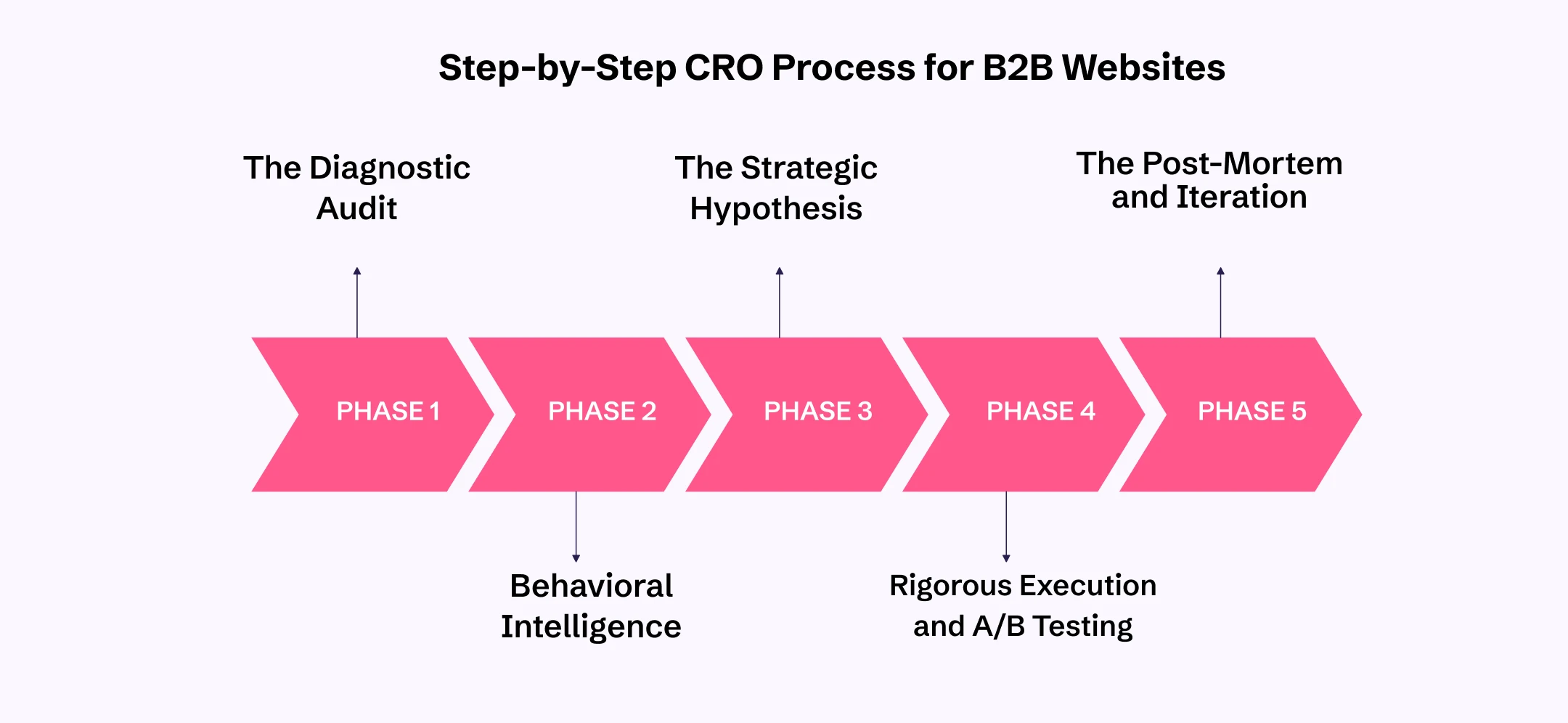
In the B2B sector, where a single lead can represent six or seven figures in annual recurring revenue, you cannot afford to treat your website like a digital brochure. You must treat it like a high-performance engine. A professional CRO process is not a series of best guesses; it is a disciplined cycle of diagnostic analysis and surgical execution.
If your team is simply changing button colors because a competitor did, you are not optimizing; you are gambling. Here is the veteran’s blueprint for a B2B conversion rate optimization framework that actually moves the needle on your bottom line.
Phase 1: The Diagnostic Audit
Before you touch a single line of code, you must understand where the revenue is escaping. We start by segmenting your website conversion rate data. Are mobile users dropping off at the pricing page? Is your ‘Request a Demo’ form seeing a 90% abandonment rate? By the start of 2026, the industry standard for B2B shifted toward intent-based auditing. Use your analytics to identify high-intent pages that underperform. If a user spends four minutes on a technical whitepaper but doesn't convert, you have a friction problem, not a traffic problem.
Phase 2: Behavioral Intelligence
Data tells you where people leave; user behavior tells you why. For high-stakes B2B decisions, the buyer’s journey is often plagued by information overload. Use heatmaps and session recordings to see where users get stuck. Are they hovering over a specific technical spec? Are they scrolling past your primary CTA because it looks like an ad? This qualitative layer turns raw numbers into actionable psychological insights.
Phase 3: The Strategic Hypothesis
A weak hypothesis leads to a failed test. A senior-level CRO process requires a formal statement: ‘Based on heatmapping data, we believe the complex 12-field lead form is intimidating prospects. By reducing this to 4 essential fields, we expect a 15% lift in demo requests because we are lowering the barrier to entry.’ This shifts the conversation from ‘I like this design’ to ‘I am testing this business logic.’
Phase 4: Rigorous Execution and A/B Testing
Now, you run the experiment. In the world of conversion rate optimisation, statistical significance is your only truth. You don’t stop a test because the first three days look promising. You wait until the data is ironclad. For B2B companies with lower traffic but higher lead values, consider split-url testing for major page overhauls to ensure you aren't tanking your existing lead flow while searching for an upgrade.
Phase 5: The Post-Mortem and Iteration
Whether a test wins or loses, it is successful if it provides data. If a test fails, it tells you what your audience doesn't value, which is just as important for your long-term CRO strategy. Take those learnings, update your user personas, and move directly into the next test. This is a marathon of incremental gains, not a sprint for a silver bullet solution.
Advanced Conversion Rate Optimization Strategies for 2026
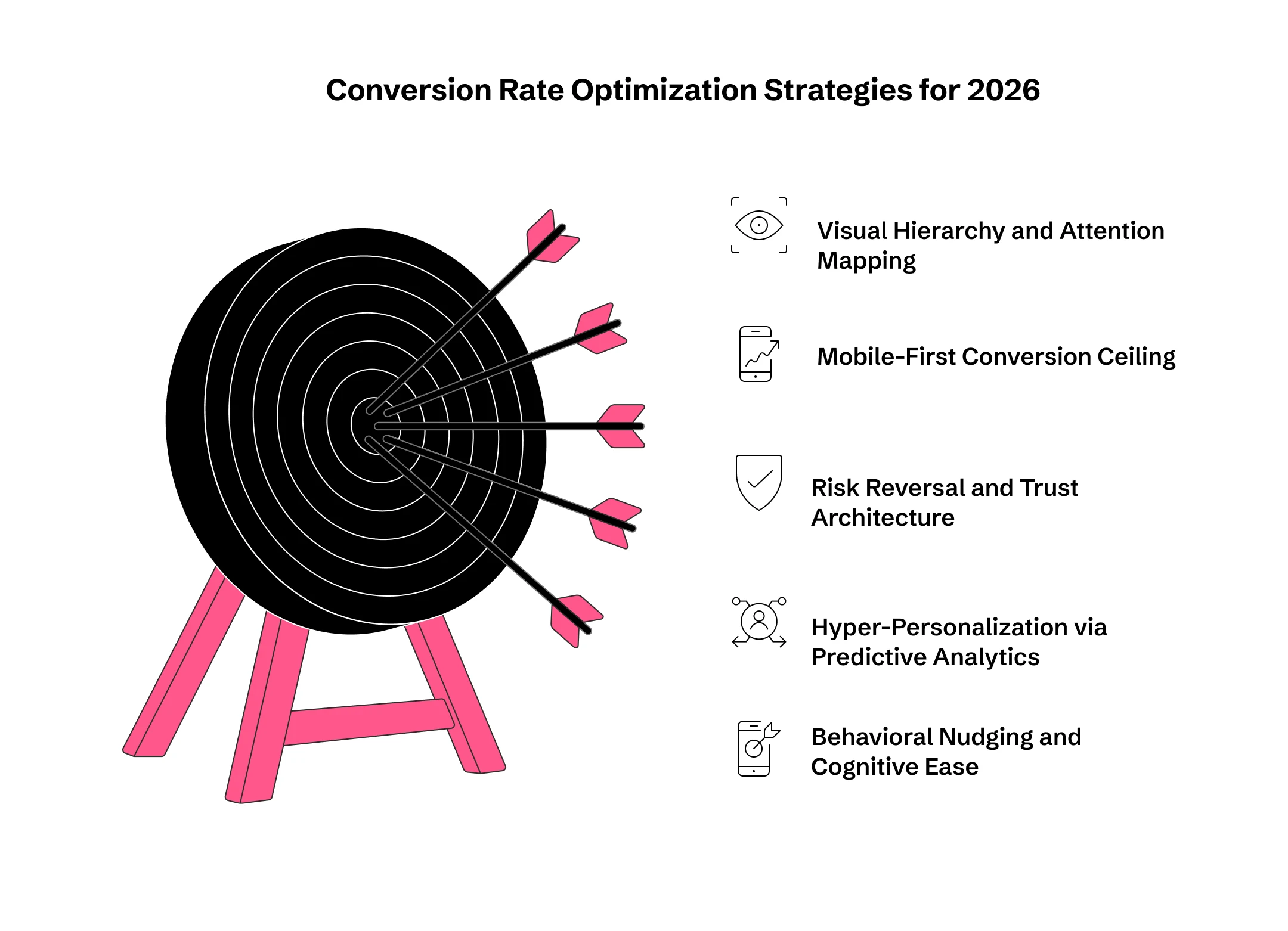
In a market where every click is increasingly expensive, you need a methodology that goes beyond basic aesthetics. Solid optimization strategies and digital marketing strategies are rooted in the intersection of behavioral economics and high-performance engineering. We are no longer just building pages; we are constructing persuasive environments.
Behavioral Nudging and Cognitive Ease
A core pillar of website conversion rate optimization is the reduction of the mental effort required to make a decision. By utilizing the principle of cognitive ease, you ensure that the information architecture feels intuitive. This involves placing critical data exactly where the eye naturally rests based on F-pattern scanning. When a prospect does not have to hunt for information, their defensive barriers drop, leading to a smoother transition from awareness to intent.
Hyper-Personalization via Predictive Analytics
A static landing page is a failing landing page. Modern CRO digital marketing leverages real-time data to adjust the value proposition based on the visitor’s firmographic background. If a visitor arrives from a healthcare enterprise, the case studies, logos, and terminology should automatically pivot to reflect healthcare challenges. This level of relevance is no longer a luxury but a baseline expectation for high-ticket B2B transactions.
Risk Reversal and Trust Architecture
B2B buyers are risk-averse. One of the most effective conversion rate optimization (CRO) strategies involves systematically dismantling every potential objection before the user reaches the CTA. This is achieved through trust architecture: integrating real-time security badges, clear data privacy guarantees, and performance SLAs directly into the conversion path. You are not just asking for a click; you are offering a partnership.
The Mobile-First Conversion Ceiling
With mobile devices now accounting for the vast majority of B2B research sessions, your website conversion optimisation must solve for the thumb-zone. This means prioritizing vertical scrolling over horizontal tabs and ensuring that interactive elements are large enough for easy engagement. If your mobile experience is a scaled-down version of your desktop site, you are likely losing half of your potential pipeline.
Visual Hierarchy and Attention Mapping
Strategic use of negative space is often more powerful than the content itself. By controlling the visual flow, you guide the user toward the primary action. This involves using high-contrast colors for conversion elements and removing any competing links that might distract the user from the main goal. Every element on a high-converting page must justify its existence by contributing to the final objective.

Website Conversion Rate Optimization Tips for Immediate Impact
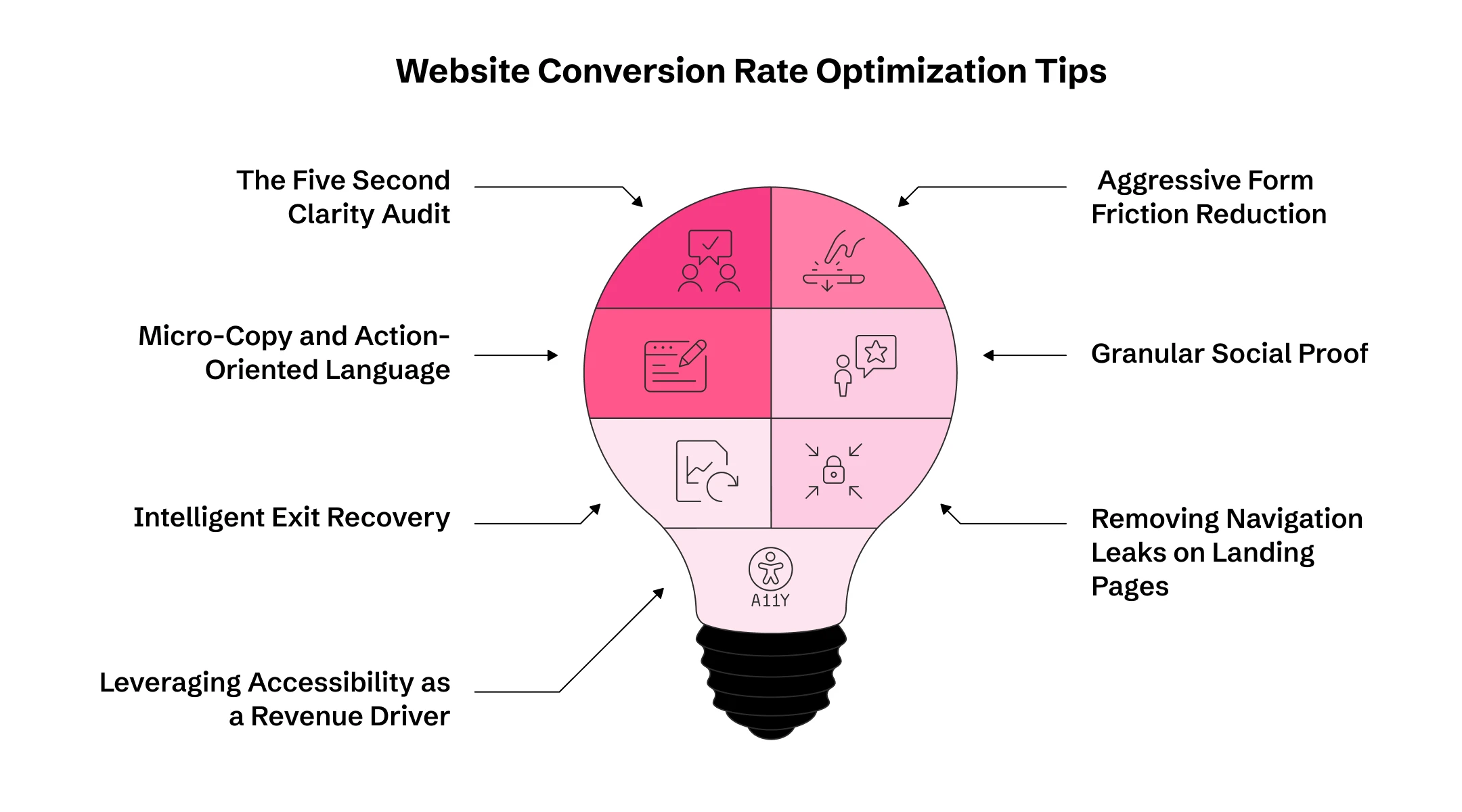
While strategies provide the long-term vision, these practical tips offer immediate ways to refine your existing assets and recover lost revenue.
The Five Second Clarity Audit
Show your site to someone unfamiliar with your brand for exactly five seconds. If they cannot identify exactly what you solve and who you solve it for, your messaging is creating a conversion bottleneck. In a high-speed digital economy, clarity wins over cleverness every single time.
Aggressive Form Friction Reduction
Senior marketers know that you should only ask for the bare minimum to qualify a lead in the first stage. Consider using social sign-on or data enrichment tools that automatically populate company details based on an email address. This reduces the work for the user while maintaining the quality of data for your sales team.
Micro-Copy and Action-Oriented Language
Avoid passive or generic terms like submit or click here. Instead, use high-intent phrases that describe the value the user will receive, such as access my strategy or view the live demo. This small change shifts the user’s focus from the effort of clicking to the benefit of the outcome.
Granular Social Proof
To boost your website conversion rate, use specific, data-backed social proof. Instead of a quote saying your service is great, use a highlight that mentions a 40 percent increase in efficiency or a 1.2 million dollar cost saving. Real-world numbers from recognizable industry peers carry far more weight than vague praise.
Intelligent Exit Recovery
Instead of a generic pop-up, offer something of genuine high value, such as a deep-dive industry report or an exclusive invitation to a technical webinar. This turns a bounce into a lead and keeps your brand at the top of their mind.
Removing Navigation Leaks on Landing Pages
CRO best practices dictate that you should remove the main header navigation and footer links. This creates a focused environment where the user has only one logical next step, significantly increasing the probability of a successful conversion.
Leveraging Accessibility as a Revenue Driver
Ensuring that your site is fully navigable via keyboard and that all visual elements have clear alt-text expands your reachable audience and signals a high level of professional standards. A site that is easy for everyone to use is a site that is easy for everyone to buy from.
Also Read: Explore The Top Digital Marketing Trends
Wrapping Up: The Future of CRO Digital Marketing
CRO is not a marketing trend. It's a fundamental business discipline that has gained urgency as acquisition costs have risen, attention spans have shortened, and digital competition has intensified.
For decision-makers, the implication of CRO in their practice is clear. CRO is not a project to schedule after other priorities are addressed. It is a standing investment in the efficiency of everything else your marketing operation does. Every dollar spent on acquisition, content, and brand is multiplied or diminished by how well your website converts the attention it earns.
The businesses that treat conversion rate optimization as a core competency and not a quarterly campaign are the ones that will compound gains while competitors are still chasing traffic
Frequently Asked Questions
What is a good website conversion rate?
For most B2B websites, anywhere between 2% and 5% is considered solid. Top-performing sites push past 10%, but that takes consistent testing and a well-structured website conversion rate optimization strategy over time.
How long does the CRO process take to show results?
Some quick fixes show results within 30 days. But real, statistically reliable improvements from a full CRO process take 3 to 6 months of disciplined testing.
Is CRO better than SEO?
Neither replaces the other. SEO pulls traffic in. CRO determines what happens after they land. Running one without the other means you're either optimizing an empty room or filling one with no exits.
What are the best CRO best practices for mobile?
Page speed is non-negotiable. Beyond that, keep forms single-column, make tap targets at least 44x44 pixels, and cut anything that adds unnecessary steps before the conversion point.
Do you need special CRO training to start?
Basic principles are learnable without formal training. But for complex experiments and accurate data interpretation, proper CRO training or working with experienced CRO companies saves you from costly testing mistakes.

Uncover executable insights, extensive research, and expert opinions in one place.
Related Content